A Winter Window, Read in Layers
A winter window read in layers helps you notice the view, changing light and nearby furnishings, so the season feels legible without redesigning the room.
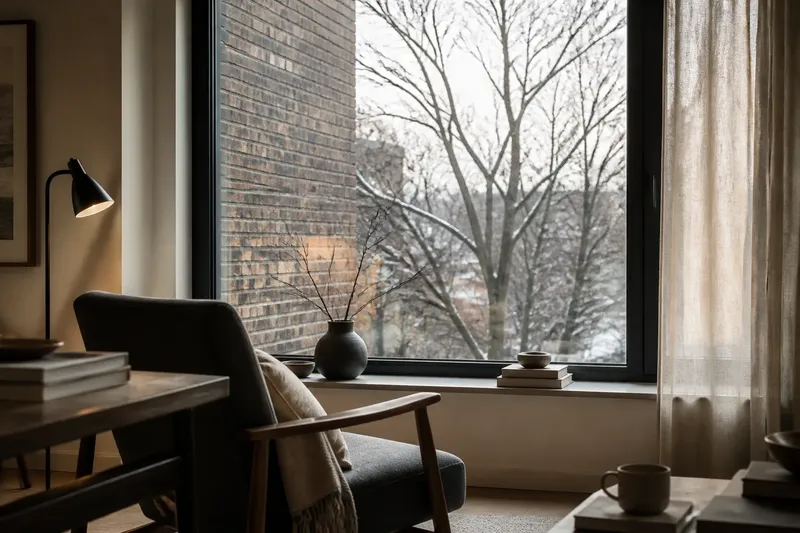
The most common mistake in reading a winter window is treating the glass as a blank hole in the wall. That misses what the window is doing: framing a view, catching a low patch of daylight and setting the nearby furniture against a seasonal backdrop. A winter window read in layers helps you notice those relationships without turning observation into a redesign project.
What changes when you read the window in layers?
Start with the view itself. Bare branches, a pale sky, wet pavement or a neighboring wall each supplies a different pattern, brightness and depth. The window frame edits that scene, cropping some details and emphasizing others.
Then look at the glass as a surface. It may reflect a lamp, a chair or the room behind you, especially as outdoor light fades. That reflection can sit over the view like a faint second image; it is not a flaw to fix, but part of what the window presents at that moment.
The third layer is the room side: the sill, curtains or blinds, wall, floor and furnishings close enough to enter the window’s visual company. A deep sill can read as a horizontal ledge; a curtain edge can act like a border; a dark chair may become a strong shape against a bright pane. None of these elements needs to be changed for the relationship to be noticed.
Which winter window approach suits your room?
There are three useful ways to observe a window: follow the view, follow the light, or follow the furnishings. They are not competing design rules. Each gives attention to a different layer, and the most useful choice depends on what seems most present in the room.
Follow the view when the outdoors carries the scene
This approach suits a window with a distinct outlook: a tree, roofline, courtyard, garden, street or even a neighboring building. Notice where the frame cuts across that view, which shapes remain visible from a seated position, and whether nearby branches or structures make a loose pattern against the sky.
In winter, the view may have fewer leaves and more visible structure. The result can feel spare rather than empty. A fence, trunk or roof edge may become the clearest line outside, while the room’s own objects appear as quieter shapes around it.
Follow the light when the view is simple
This approach suits a window facing a plain wall, a modest courtyard or a stretch of sky without much detail. Watch how daylight occupies the glass and the surfaces beside it. The light may appear broad and diffuse on an overcast day, or form a narrower bright area when the sky clears.
Pay attention to where that brightness meets a wall, tabletop or fabric. A pale curtain may seem to merge with the window; a darker frame may mark its edge more sharply. The point is not to rate the room as bright or dim, but to notice where the eye pauses.
Follow the furnishings when the room competes for attention
This approach suits a window close to a sofa, desk, dining table or reading chair. Look at the window and the object together, rather than judging either alone. The furniture may interrupt the view, echo its shape or give the window a clear foreground.
A chair turned toward the glass suggests that the view is meant to be noticed. A table placed across the line of sight can make the window feel more like a backdrop. Those impressions are descriptive, not verdicts on the arrangement.
How should you observe a winter window?
What should you notice first?
Begin with the broadest shape: the opening, the view within it and the nearest large object. Then move to smaller details such as a curtain edge, sill ornament or reflection. This order makes it easier to distinguish the scene from the visual clutter that accumulates around almost any window.
Does the window look different from a chair?
Yes, because the view is always framed from a particular height and angle. Sit where you normally sit and notice which parts of the outdoors remain visible, then compare that impression with the view while standing. The difference may explain why a window feels expansive from one spot and mostly reflective from another.
What does a reflection add?
A reflection brings the room into the view, often layering a lamp, artwork or furniture over the outdoors. Notice what appears in the glass and what disappears when you shift your position. This is especially useful in the evening, when the exterior may become less distinct and the interior reflection more prominent.
Should you change anything you notice?
Not necessarily. Observation can be the whole exercise: it may simply make a familiar corner more legible, or clarify which part of the scene holds your attention. If you are considering an alteration, first check the relevant product instructions and any applicable local requirements.
How do the three approaches compare?
- View-led: Best when the outdoor scene has distinct shapes or depth. It tells you how the window frames what lies beyond.
- Light-led: Best when the exterior is visually quiet. It draws attention to brightness, reflections and the surfaces beside the glass.
- Furnishing-led: Best when seating or a table sits close to the window. It shows how the interior and exterior share the same frame.
Choose by asking what you notice before you try to explain it. If your eye goes straight to a tree or roofline, start with the view. If you notice a patch of light first, follow that. If you register the chair or table as part of the scene, begin with the furnishings.
Say you have a north-facing window overlooking a plain brick wall, with a reading chair nearby. You notice first that the chair’s dark back forms a distinct shape against the pale glass, while the wall outside offers little detail. Following the furnishings is the clearest route: it lets you see how the chair anchors the window, without assuming either object needs to move.
What is not worth the effort?
There is little value in trying to assign a fixed meaning to every detail: a bare branch need not signify calm, and a reflection need not be an aesthetic problem. Avoid turning one cloudy afternoon into a verdict on the whole room. The view, daylight and reflections change, and that variation is precisely what makes the window worth observing.
It is also not necessary to record every change or compare the room as if it were a controlled experiment. A glance from your usual seat, followed by a second look at a different time of day, is enough to reveal whether the view, light or furnishings are doing most of the visual work.
What can a winter window tell you about the room?
A window can show where the room’s attention naturally gathers. The outdoors may provide the strongest pattern, the glass may hold a faint reflection, or nearby furnishings may give the opening its sense of scale. Winter makes these relationships easier to see when branches thin and daylight shifts across the room, but the observation applies in any season.
Use a winter window read in layers as a way to look more carefully, not as a concealed instruction to redecorate. Once you know whether the view, light or furnishings lead the scene, you can decide whether that is already the effect you want. Sometimes the useful discovery is simply that the room has been framing something well all along.